



Press Release
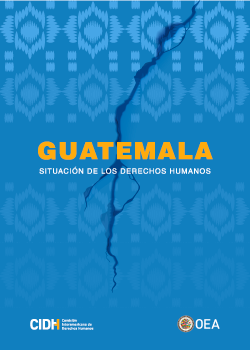
IACHR issues report on the situation of human rights in Guatemala
December 1, 2025
Contact info
IACHR Press Office
Distribution List

Washington, DC—The Inter-American Commission on Human Rights (IACHR) issued the report Situation of Human Rights in Guatemala, the outcome of an on-site visit to the country conducted over the period July 22–26, 2024. The report looks at the structural changes affecting the enjoyment of human rights in Guatemala—particularly those linked to a process where democratic institutions and judicial independence are being weakened—since the IACHR’s previous visit to the country in 2017, with updates up to 2025.
The IACHR found that Guatemala is facing serious threats to governance and the democratic rule of law because some State institutions are under the control of external actors—political and economic—that defend vested interests and seek to perpetuate privilege and ensure impunity.
The report explains how the public prosecutor’s office is ignoring its legal, constitutional mandate of exercising criminal action in independent, autonomous, and objective ways in defense of citizens’ general interest. This institution has been coopted and dismantled so it operates as an instrument for selective persecution. The Office of the Special Prosecutor Against Impunity (FECI), which in the past led landmark cases to fight impunity, now works to perpetuate the status quo and persecute anyone who questions the current state of affairs. Evidence of this is apparent in actions adopted by the Office of the Attorney General and backed by some judicial officers to question the results of the 2023 general election, in an ongoing effort to undermine the government’s democratic mandate and legitimacy.
Since 2017, criminalization has been used against judicial officers and former officials of the International Commission against Impunity in Guatemala (CICIG) who tried to investigate the vested interests of elites and other groups involved in acts of corruption. Criminalization clearly seeks to protect the impunity and privileges of specific sectors. The IACHR notes in its report that efforts to manipulate criminal law have been expanded to target individuals who are active as legal counsel in favor of criminalized persons, indigenous and peasant communities, trade unions, journalists, students and academic staff, public officials (including judicial officers), a former public prosecutor for human rights, and even the country’s president and vice president. This practice seeks to serve as a collective deterrent and has led to self-censorship in civic space, whether physical or digital.
The situation has also been made possible by the fact that the public prosecutor’s office and some sectors of the judiciary share certain vested interests and have contributed to legitimizing selective criminal prosecution processes without the required safeguards, sometimes even involving arbitrary deprivation of liberty. At the same time, judicial officers who have acted in keeping with the law have been subjected to harassment, stigmatization, threats, arbitrary transfers, and unwarranted criminal proceedings, which has led many of them to go into exile.
In this context, impunity has deepened, especially in large-scale corruption cases and in cases linked to crimes committed during Guatemala’s internal armed conflict. During its recent visit, the IACHR found a pattern where transitional justice proceedings were being obstructed, shelved, or delayed; judicial rulings were being adopted in violation of Guatemala’s international obligations; and discussion of amnesty bills was operating as a constant threat. The fact that several institutions created in the country’s Peace Accords have been dismantled has compromised the State’s ability to respond to victims’ demands and to comply with its own international obligations in terms of truth, justice, reparation, and guarantees of non-recurrence.
The IACHR stresses the urgent need to adopt structural reforms in the justice system in order to ensure judicial independence, enable recruitment and appointment procedures based on international merit, objectivity, and transparency standards, as well as to implement accountability mechanisms to address the arbitrary use of criminal law. Upcoming proceedings to renew the Constitutional Court, the Supreme Electoral Court, and the Office of the Attorney General provide an opportunity to restore the legitimacy of the justice system and to strengthen democratic institutions.
In its report, the IACHR concludes that Guatemala continues to face significant challenges in the fight against poverty and inequality, as well as to ensure full enjoyment of economic, social, cultural, and environmental rights. These challenges include concentrated economic power, weak State structures with little tax-collection capacity, high levels of corruption, and a context where discrimination, violence, racism, and exclusion are rife against indigenous peoples and rural and Afro-descendant communities. Further, severe restrictions persist in access to rights including the rights to water and sanitation, health, education, food, employment, social security, and a healthy environment.
Indigenous peoples live in conditions of extreme deprivation compared to the rest of the population, with restrictions in access to basic services including electricity, decent housing, employment opportunities, and justice. The lack of legal certainty and the coordinated actions of private firms, the judiciary, and the public prosecutor’s office have led to a misappropriation of the ancestral lands of indigenous communities and to forced evictions. This scenario shows that the discriminatory economic, cultural, and social relations that led to Guatemala’s internal armed conflict still prevail today. Their effects are made worse by the impact of natural disasters and climate change, by the perpetuation of poverty, and by high migration rates.
The work of rights defenders remains high-risk in Guatemala, amid serious violence and abuse of criminal law as tools for harassment, intimidation, and obstruction, particularly against indigenous and peasant communities and defenders of land, territory, and the environment. Similarly, women who are rights defenders face gender-based violence and differentiated criminalization patterns. The IACHR acknowledges some recent institutional progress to protect defenders. Effectively implementing the applicable policy based on the 2014 ruling of the Inter-American Court of Human Rights should be a priority.
The IACHR report also mentions the situation of indigenous and Afro-descendant persons, women, LGBTI persons, children and adolescents, older persons, persons with disabilities, individuals in human mobility contexts, individuals who are deprived of liberty, and people whose lives are marked by inequality, exclusion, and violence. While several initiatives have been adopted to address the specific needs of these groups, challenges remain to ensure they enjoy the same rights as other people in Guatemala.
The IACHR made 43 recommendations to the State about all these matters. The IACHR stresses its commitment to helping Guatemala to restore its democratic institutions, based on protecting and ensuring respect for human rights, fighting impunity, implementing historical memory, granting comprehensive reparations to victims, complying with the commitments made in the Peace Accords, and adopting effective policies to reduce inequality. The IACHR stresses that this process requires the political will of all three branches of government—beyond specific administrations—as well as the participation of Guatemalan civil society and the determined support of the international community.
The IACHR is an autonomous body of the Organization of American States (OAS) whose mandate is based on the OAS Charter and the American Convention on Human Rights. Its mission is to promote and defend human rights throughout the Americas and to serve as an advisory body to the OAS in this area. The IACHR consists of seven independent members elected by the OAS General Assembly who serve in a personal capacity and do not represent their countries of origin or residence.
No. 245/25
11:00 AM